Install SoundCarrot
Add it to your home screen for quick access.
Listened
In progress
If you’ve heard the hammering of a woodpecker in the woods, you might have wondered how the birds can be so forceful. What does it take to whack your head against a tree repeatedly, hard enough to drill a hole? A team of researchers wondered that too and set out to investigate, by putting tiny muscle monitors on eight downy woodpeckers and recording them with high-speed video as they pecked away in the lab.
Integrative organismal biologist Nick Antonson, co-author of a report on the work, joins Host Flora Lichtmen to peck away at the mystery.
If you’ve heard the hammering of a woodpecker in the woods, you might have wondered how the birds can be so forceful. What does it take to whack your head against a tree repeatedly, hard enough to drill a hole? A team of researchers wondered that too and set out to investigate, by putting tiny muscle monitors on eight downy woodpeckers and recording them with high-speed video as they pecked away in the lab.
Integrative organismal biologist Nick Antonson, co-author of a report on the work, joins Host Flora Lichtmen to peck away at the mystery.
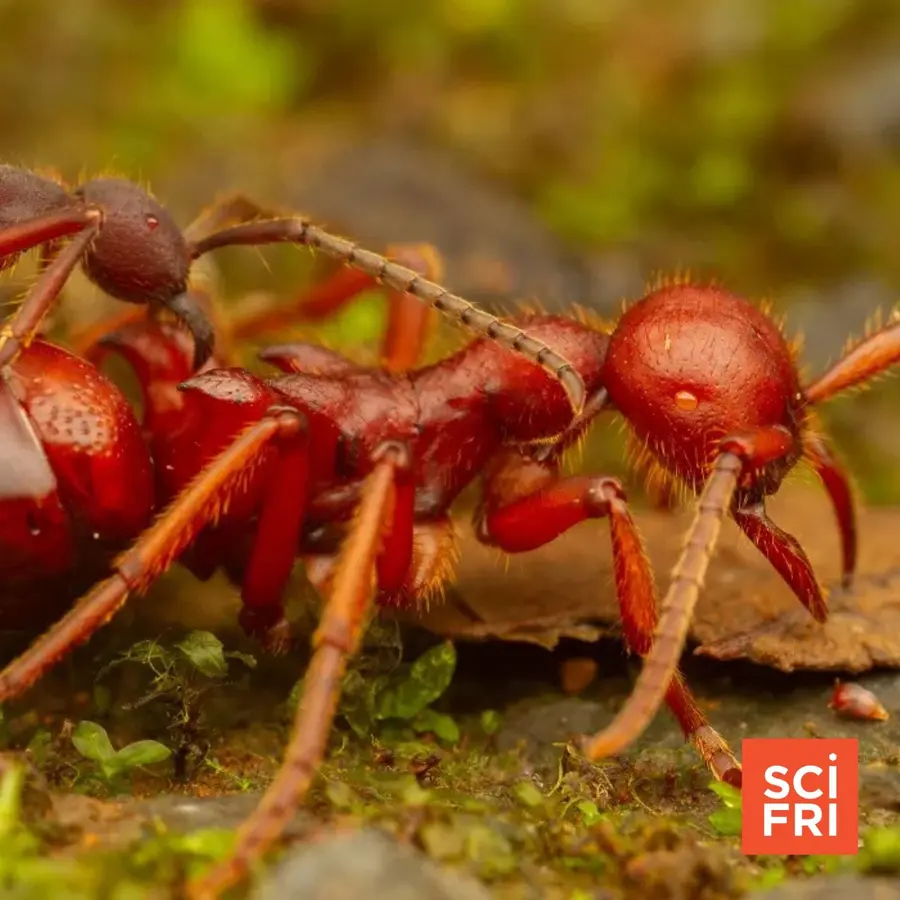
Plus, you can take two ant eggs with the exact same genes, and one can grow up to be a queen, the other a worker. Neuroscientist and evolutionary biologist Daniel Kronauer joins Flora to share recent research into how an ant becomes a queen.
Guests: Dr. Nick Antonson is an NSF postdoctoral research fellow in the department of ecology, evolution, and organismal biology at Brown University.
Dr. Daniel Kronauer is the Stanley S. and Sydney R. Shuman Professor in the Laboratory of Social Evolution and Behavior at The Rockefeller University in New York.
Transcripts for each episode are available within 1-3 days at sciencefriday.com.
Subscribe to this podcast. Follow our show on Instagram, TikTok, Facebook, and Bluesky @scifri and sign up for our newsletters. Got a science question that’s keeping you up at night? Call us: 877-472-4374
Hosted by Simplecast, an AdsWizz company. See pcm.adswizz.com for information about our collection and use of personal data for advertising.
QUICK LINKS

This is an episodic podcast, so you can listen to it in any order, but episode one is a great place to start.
Listen to episode one hereIf you’ve heard the hammering of a woodpecker in the woods, you might have wondered how the birds can be so forceful. What does it take to whack your head against a tree repeatedly, hard enough to drill a hole? A team of researchers wondered that too and set out to investigate, by putting tiny muscle monitors on eight downy woodpeckers and recording them with high-speed video as they pecked away in the lab.
Integrative organismal biologist Nick Antonson, co-author of a report on the work, joins Host Flora Lichtmen to peck away at the mystery.
Plus, you can take two ant eggs with the exact same genes, and one can grow up to be a queen, the other a worker. Neuroscientist and evolutionary biologist Daniel Kronauer joins Flora to share recent research into how an ant becomes a queen.
Guests: Dr. Nick Antonson is an NSF postdoctoral research fellow in the department of ecology, evolution, and organismal biology at Brown University.
Dr. Daniel Kronauer is the Stanley S. and Sydney R. Shuman Professor in the Laboratory of Social Evolution and Behavior at The Rockefeller University in New York.
Transcripts for each episode are available within 1-3 days at sciencefriday.com.
Subscribe to this podcast. Follow our show on Instagram, TikTok, Facebook, and Bluesky @scifri and sign up for our newsletters. Got a science question that’s keeping you up at night? Call us: 877-472-4374
Hosted by Simplecast, an AdsWizz company. See pcm.adswizz.com for information about our collection and use of personal data for advertising.
Sound Carrot is your source for Family Podcast Discovery. Verified awesome, 0% boring.
Distraction free website, no flashing banners or adverts to steal your attention.
(Some shows do contain their own ads however).
At first I made this site for my kids, but like any dad I got a little over excited. I hope you find it as useful as they do.
Whether you want to listen to them together in the car, or alone in your room - the content is all safe for younger ears.