Install SoundCarrot
Add it to your home screen for quick access.
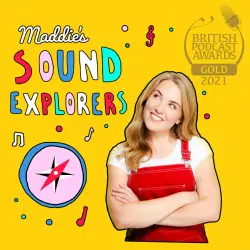
Parent info: Maddie's Sound Explorers is recommended for ages under 5 and 6-10 and 11 plus. It's an Episodic show that can be listened to in any order. Made in the UK, it's about Education and Music for kids. Launched in 2020, it has 1 season.
Oh no! This episode has gone missing! It might have been renamed or removed by the podcast maker. But don't worry - there are plenty more episodes to explore!
Stefan Gates guides us on the rocky journey that our food takes - starting with the mouth and stomach and all the way through the intestines. We also find out whether farting is bad for you! We have some Big Bowel Beats this episode to round off our journey.
We travel into the past, present and future with Dr Alice Bell to learn about the history of the car engine - from steam power to the electric cars of the future. The cranks, steam and motors of the past and electric hum of the future gives us our song of the …
Maddie talks to her mum, beekeeper Sabra Moate, and we travel into a hive to hear some busy bees doing their waggledance - and at the end of the episode, we’ll be doing a busy, buzzy waggledance of our own.
Urban Birder David Lindo joins us to do some birding close to home - and to learn about what their calls mean.
We go to the beach with Dr Helen Burningham to learn how beaches form, and how long they will last.
Maddie and Dr Sheila Kanani accidentally get sucked into a vacuum cleaner - and use the opportunity to understand a vacuum, and why space isn’t quite as quiet as you might think.
We journey down our drains with water engineer Yewande Akinola, following the journey of the water from when it swirls away down the drain until it turns up, clean, back in our taps.
Dr Laura Porro takes us back to the Mesozoic era to hear the sounds of the smallest, the biggest, and the most ferocious dinosaurs.
We take a ride into space with Emily Calandrelli, learning about rockets and the future of space travel. Our song takes us out into space with a solar sail!
We fly up into a fluffy cumulus cloud with Ayesha Tandon, and learn about where clouds come from - and what they’re made from. The rhythm of the rain on the window leads us into our song of the week.
Charlotte Corney, zookeeper extraordinaire, travels with us to watch big cats in the wild - and we learn how they communicate.
Professor Carolyn Ross jumps into a bowl of cereal to answer this important question - and we learn about how useful food science can be for young children.
Weather presenter Alex Deakin joins us at the heart of a thunderstorm as we learn how thunder and lightning are created.
We learn about what an echo is - and how bats use echoes to get around, visiting a bat cave with Biologist Professor Kate Jones. Our batty music uses the singing of bats with a jazz twist.
Professional Space Nerd Dr Jen Gupta takes us to the beginning of the universe - the moment before the big bang - and we learn about the signs of the big bang that are still with us today. Our big banger uses the sound of the birth of the universe to make a pa…
Introducing Maddie's Sound Explorers; a brand new podcast launching on Tuesday 4th August exploring the sounds of science and nature with host, Maddie Moate! In each episode, we'll bring you a new piece of music made from the noises we discover. Listen out for…
Content, Artwork and advertising within this podcast is not owned or affiliated with Sound Carrot.

No similar shows for this age just now.
Sound Carrot is your source for Family Podcast Discovery. Verified awesome, 0% boring.
Distraction free website, no flashing banners or adverts to steal your attention.
(Some shows do contain their own ads however).
At first I made this site for my kids, but like any dad I got a little over excited. I hope you find it as useful as they do.
Whether you want to listen to them together in the car, or alone in your room - the content is all safe for younger ears.